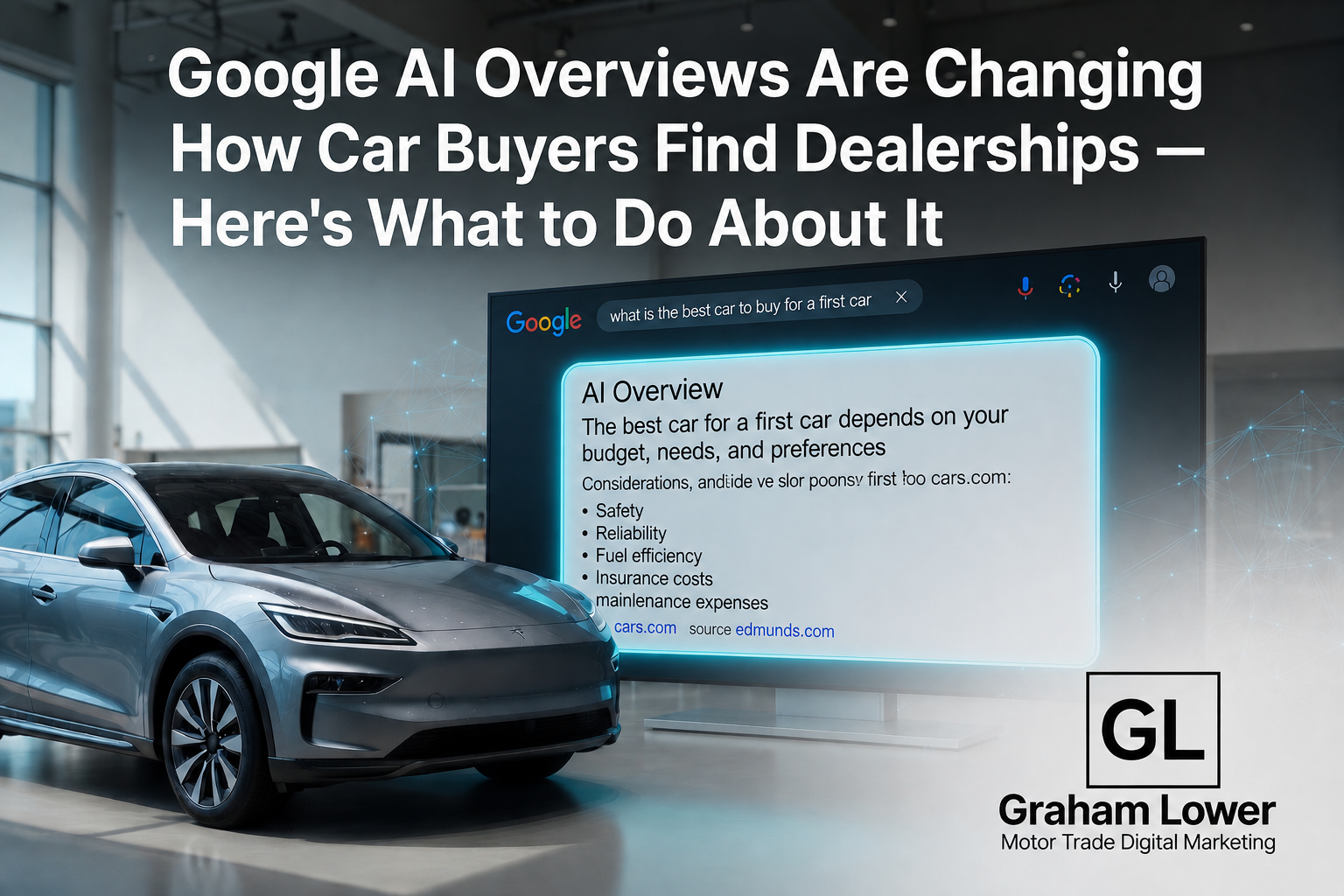
If your dealership’s website has seen fewer organic visitors over the last year—even though your Google rankings haven’t changed—you may already be feeling the effects of Google’s AI Overviews.
For many informational searches, Google no longer sends users directly to websites. Instead, it answers their questions at the top of the search results using AI-generated summaries compiled from multiple sources.
For dealerships, that’s a significant change.
Today’s buyers spend days or even weeks researching models, finance options, electric vehicles, servicing and ownership costs before they contact a dealership. If Google answers those questions before a customer visits your website, you risk losing valuable opportunities to build trust, generate enquiries and influence buying decisions.
The good news is that this isn’t the end of search engine optimisation (SEO). It’s the next stage of it.
Dealerships that create genuinely helpful, answer-first content backed by real automotive expertise are well placed to remain visible—not only in traditional search results, but increasingly inside Google’s AI-generated answers.
This guide explains what AI Overviews are, why they matter to UK franchised dealerships, and the practical steps you can take today to improve your visibility in AI-powered search.
Quick Answer
Google AI Overviews are AI-generated summaries that appear above traditional search results for many informational searches. They can reduce website clicks because Google answers a user’s question directly within Search. Dealers can improve their chances of being cited by publishing answer-first content, demonstrating genuine automotive expertise, maintaining strong technical SEO and making their websites easy for Google’s systems to understand.
Key Takeaways
- AI Overviews are changing how customers discover dealerships online.
- Informational searches are more likely to trigger AI Overviews than transactional searches.
- Traditional SEO remains essential, but answer-first content has become increasingly important.
- Dealerships with genuine expertise and well-structured content are better positioned for AI visibility.
- Dealers who adapt now will have a competitive advantage while many competitors are still relying on brochure-style websites.
What Are Google AI Overviews?
Google AI Overviews are AI-generated summaries that answer many search queries directly within Google Search. Instead of showing only a list of websites, Google combines information from multiple trusted sources to provide a concise answer before the traditional organic results.
For consumers, this creates a faster way to find information.
For businesses, it fundamentally changes how people discover websites.
Imagine a customer searches:
- Is the Volvo XC60 reliable?
- What’s the difference between PCP and HP?
- Should I buy a hybrid or an electric car?
- Is an Approved Used car worth the extra money?
Five years ago, that customer would probably click through to several websites before finding an answer.
Today, Google may answer the question immediately.
If the customer receives enough information within the AI Overview, they may never visit your website at all.
That’s why visibility inside AI-generated search results is becoming just as important as ranking on the first page of Google.
It’s important to remember that AI Overviews don’t appear for every search.
They are most common for informational, comparison and research-focused queries—the very searches customers make during the early stages of buying a car.
Searches with strong purchase intent, such as:
- Volvo dealer Brighton
- Used BMW X3 for sale near me
- Book a service
- Kia dealership Eastbourne
are still much more likely to display traditional local search results, maps and dealership websites.
Understanding this difference is the first step in adapting your dealership’s content strategy.
Why Should Dealer Principals Care?
AI Overviews are changing where customers get their information during the research phase of the buying journey. If your dealership isn’t part of those answers, you risk becoming less visible before customers are ready to enquire.
Many dealer principals monitor website traffic, leads and sales but don’t regularly analyse how customers actually consume information before making contact.
That journey has changed dramatically.
Before visiting a dealership, today’s buyers ask Google questions like:
- Which SUV is best for a growing family?
- Is an electric car worth buying?
- How long does PCP last?
- What happens at the end of a finance agreement?
- Is an Approved Used vehicle safer than buying privately?
These are exactly the types of searches that frequently trigger AI Overviews.
Recent independent research has found that AI Overviews can reduce organic click-through rates by up to 34.5% for affected searches. The impact varies depending on the query and user intent, but the overall trend is clear: fewer users are clicking through to websites for informational searches.
That doesn’t necessarily mean your dealership will lose 34.5% of its enquiries.
However, it does mean fewer opportunities to educate potential buyers, demonstrate expertise and build trust before they begin comparing dealerships.
For privately owned and family-run franchised dealers, this creates both a challenge and an opportunity.
Large dealer groups often rely on brand recognition and substantial marketing budgets.
Privately-held franchised dealers have another advantage: authentic expertise.
Your sales managers, service advisors and technicians answer customer questions every day. The knowledge already exists within your business.
The dealerships that capture and publish that expertise in a way Google can understand are likely to be in a much stronger position than those relying solely on manufacturer-provided content.
Why AI Overviews Are Different From Traditional SEO
Traditional SEO focuses on helping pages rank. AI Overviews focus on helping Google answer questions. While the two are closely connected, they are not the same thing.
For years, SEO professionals concentrated on improving rankings for individual keywords.
That remains important.
However, Google’s AI systems increasingly look for content that answers questions clearly, demonstrates expertise and can be understood with confidence.
Think about the difference between these two opening paragraphs.
Example One
Welcome to ABC Motors. We’ve proudly served motorists across Sussex for over 40 years, offering new and Approved Used vehicles together with servicing, MOTs and finance solutions.
Example Two
An Approved Used car from a franchised dealership typically includes a comprehensive inspection, warranty, vehicle history checks and roadside assistance, making it a lower-risk purchase than buying privately.
The second example answers the customer’s question immediately.
The first introduces the business.
Both have a place—but if the page is trying to answer “Should I buy an Approved Used car?”, the second example gives Google something it can understand and potentially cite.
That doesn’t mean every page should become robotic or read like an encyclopaedia.
It means the answer comes first.
The explanation, examples and your dealership’s unique perspective come afterwards.
This simple shift in writing style is one of the biggest opportunities available to dealerships today.
How Google Decides Which Content Appears in AI Overviews
Google hasn’t published the exact formula for selecting sources in AI Overviews. However, current evidence suggests that pages are more likely to be cited when they answer questions clearly, demonstrate genuine expertise, are technically well structured and already have strong overall search signals.
One of the biggest misconceptions surrounding AI Overviews is that Google simply copies information from the websites ranking in first place.
That’s not how it appears to work.
Pages that rank well certainly have an advantage because Google already considers them authoritative. However, studies analysing AI Overview citations have shown that Google can also reference content from pages that aren’t ranked in the top three—or even on the first page—for a particular search.
What those pages often have in common isn’t a specific ranking position.
It’s clarity.
They answer the question directly.
They provide evidence.
They demonstrate expertise.
They are easy for Google’s systems to understand.
For dealership websites, that’s encouraging.
You don’t always need to outrank Auto Trader, manufacturer websites or national publishers to become part of the conversation. Sometimes you simply need to provide the clearest, most trustworthy answer to the question the customer is asking.
The Answer-First Content Framework Every Dealer Should Follow
If you want your dealership’s content to be easier for Google’s AI to understand, structure every page so that the answer comes before the explanation.
Think about how your sales team answers questions on the showroom floor.
If a customer asks:
“Is PCP better than HP?”
Your salesperson doesn’t spend five minutes talking about the history of vehicle finance.
They answer the question.
Then they explain why.
Your website should do exactly the same.
A simple framework works remarkably well:
Answer
Provide a concise answer in the opening paragraph.
Evidence
Support the answer with facts, experience, or research.
Explanation
Explain why the answer is correct.
Example
Use a real-world dealership scenario that customers can relate to.
Next Step
Guide the reader towards another helpful resource or contacting your dealership.
This structure benefits both readers and AI systems because every section becomes easy to understand without losing depth.
Example: Before and After
Before
Choosing the right finance agreement can be confusing because there are many different options available, and every customer’s circumstances are unique. At ABC Motors, our finance specialists have many years of experience helping customers make informed decisions.
Eventually, the page answers the question.
But only after the visitor has already read several sentences.
After
PCP is usually better for drivers who like changing their car every few years, while HP is often better for buyers who want to own the vehicle outright without a final balloon payment.
From there you can explain:
- how each finance option works
- the advantages
- the disadvantages
- who each option suits
- examples from your dealership
The customer gets an immediate answer.
Google gets a clear answer.
Everyone wins.
Stop Writing Brochures. Start Answering Questions.
Many dealership websites still read like digital brochures. AI Overviews reward websites that educate rather than simply promote.
Manufacturer websites already provide vehicle specifications.
Every dealership talks about excellent customer service.
Most websites describe themselves as trusted, friendly and professional.
None of that helps customers answer their questions
Instead, think about what your sales team hears every day.
Questions like:
- Is an electric vehicle suitable for motorway driving?
- Should I lease or finance my next car?
- Can I part exchange a vehicle with outstanding finance?
- Is an Approved Used car worth paying more for?
- How long do hybrid batteries last?
- Can I charge an electric car at home?
Every one of those questions could become an article.
Every one could become an FAQ.
Every one could become a section within a model page.
Most importantly, every one represents the language your customers actually use.
When your website mirrors those conversations, it becomes more useful for buyers—and easier for Google’s AI to interpret.
Your Biggest Competitive Advantage Isn’t AI—It’s Experience
AI can summarise information. It cannot replace decades of real dealership experience.
This is where privately held and family-owned franchised dealers have a genuine opportunity.
Every day your business generates insights that no AI model can invent.
Your technicians know which faults appear most often after 80,000 miles.
Your business manager knows the finance questions customers struggle with.
Your sales managers understand why one family chooses an SUV while another buys an estate.
Your aftersales team knows the servicing concerns owners ask every week.
That’s original expertise.
It’s exactly the kind of experience that generic AI-written content cannot reproduce.
Rather than trying to publish more content than your competitors, publish better content.
Write from experience.
Use examples.
Share practical advice.
Explain the reasoning behind your recommendations.
Customers trust that.
Increasingly, Google’s systems appear to value it too.
Build Topical Authority Instead of Chasing Individual Keywords
The dealerships most likely to succeed in AI-powered search won’t publish one great article. They’ll build complete knowledge hubs around the questions their customers ask.
Imagine your dealership sells Volvo vehicles.
Instead of writing one article called:
Volvo XC60 Review
Create a connected collection of content:
- Is the Volvo XC60 reliable?
- Volvo XC60 running costs explained
- Volvo XC60 vs BMW X3
- Volvo XC60 vs Audi Q5
- Is the XC60 good for families?
- Common Volvo XC60 questions
- Volvo XC60 ownership costs
- Best XC60 engine
- Should I buy a new or Approved Used XC60?
Now Google doesn’t just see a dealership.
It sees a specialist.
Internal linking becomes stronger.
Customers stay on your website longer.
Search engines better understand your expertise.
This approach builds topical authority—the breadth and depth of coverage around a subject—which is far more sustainable than targeting isolated keywords.
Does Schema Help AI Overviews?
Structured data helps search engines understand your content, but Google has not said that any specific schema type guarantees inclusion in AI Overviews.
This is an area where there’s a lot of misinformation.
Adding schema alone won’t make your pages appear in AI Overviews.
Equally, schema remains an important part of a technically strong website because it helps search engines understand entities, relationships and page purpose.
For dealership websites, I recommend continuing to implement:
- Organisation schema
- Person schema
- Website schema
- Webpage schema
- Article schema
- Breadcrumb schema
- Local Business schema where appropriate
If you publish genuine question-and-answer sections, FAQPage schema can still be useful for describing the page’s structure. However, it should be seen as supporting technical SEO rather than as a shortcut to AI Overview visibility.
The foundation is still the content itself.
Clear answers.
Real expertise.
Helpful information.
Schema simply helps Google interpret it.
A Practical AI Optimisation Checklist for Dealers
Before publishing any page, ask yourself:
✅ Does the first paragraph answer the question immediately?
✅ Would the opening paragraph make sense if Google quoted it on its own?
✅ Have I demonstrated real dealership experience?
✅ Is the advice genuinely useful rather than promotional?
✅ Have I used headings based on real customer questions?
✅ Is the page internally linked to related content?
✅ Is the author clearly identified?
✅ Is the information current and accurate?
If you can’t answer “yes” to most of these questions, the page probably needs further work before you publish it.
The Biggest Mistakes Dealerships Are Making
The biggest threat to your dealership’s visibility isn’t Google’s AI. It’s continuing to publish content that no longer matches how customers search.
After reviewing hundreds of dealership websites, the same problems appear repeatedly.
Most aren’t technical.
They’re content problems.
Writing for search engines instead of customers
Many dealership websites still create pages around keywords rather than customer questions.
Customers don’t search for:
Volvo XC60 Brighton dealership information
They search for:
- Is the Volvo XC60 reliable?
- Is PCP better than HP?
- What’s included with Approved Used?
- Is an electric car right for me?
If your content doesn’t answer those questions, you’re missing the opportunity to become part of the buying journey.
Leading with sales copy
Too many pages begin like this:
Welcome to ABC Motors, your trusted local dealership serving Sussex for over 40 years…
There’s nothing wrong with saying that.
It’s just not the answer the visitor came looking for.
Answer first.
Sell later.
Trust follows usefulness.
Publishing manufacturer content
Manufacturer-approved copy creates another problem.
If every dealership publishes almost identical descriptions of the latest model, Google has very little reason to choose your website over the manufacturer’s own pages.
Instead, explain:
- what customers ask about the vehicle
- common ownership questions
- real-world running costs
- who the vehicle suits
- common misconceptions
- practical buying advice
Those are insights only an experienced dealership can provide.
Forgetting the research phase
Many dealerships optimise only for transactional searches like:
- Used Volvo XC60 Brighton
- Kia dealer Sussex
- Book a service
Those searches remain important.
However, customers usually begin with informational questions days or weeks before they’re ready to buy.
If you’re absent from those searches, someone else earns the customer’s trust first.
Traditional SEO Still Matters
AI Overviews haven’t replaced SEO. They’ve made good SEO even more important.
There’s a misconception that AI has changed everything.
It hasn’t.
Google still relies on many of the same signals that have mattered for years.
Continue investing in:
- technical SEO
- page speed
- mobile usability
- internal linking
- local SEO
- Google Business Profile optimisation
- customer reviews
- crawlability
- structured data
- helpful content
Think of AI optimisation as another layer built on top of traditional SEO—not a replacement for it.
If your technical SEO is weak, answer-first writing alone won’t solve the problem.
Likewise, excellent technical SEO won’t compensate for thin, generic content.
The strongest websites combine both.
A 90-Day Action Plan for Dealerships
You don’t need to rebuild your website. You need to improve your most important pages first.
Here’s the process I recommend.
Weeks 1–2
Audit your existing content.
Identify:
- pages receiving the most organic traffic
- pages targeting informational searches
- pages ranking between positions 4 and 20
- pages with declining click-through rates
These usually provide the quickest opportunities.
Weeks 3–4
Rewrite the introductions.
Every page should answer its primary question within the opening paragraph.
Remove unnecessary introductions.
Move explanations below the answer.
Month Two
Expand your content.
Create dedicated pages answering the questions your sales and aftersales teams hear every day.
Don’t guess.
Ask them.
Your dealership already has a constant source of content ideas.
Month Three
Strengthen your authority.
Review:
- author pages
- internal links
- structured data
- article freshness
- supporting evidence
- original photography
- customer examples
Then repeat the process.
AI optimisation isn’t a one-off project.
It’s an ongoing content strategy.
Frequently Asked Questions
Will AI Overviews replace dealership websites?
No. Customers still visit dealership websites to compare vehicles, browse stock, book services and contact retailers. AI Overviews mainly affect informational searches during the research phase of the buying journey.
Do I need to rewrite every page?
No.
Start with the pages that already receive traffic or target common customer questions.
Improving your most valuable pages first usually delivers the greatest return.
Is structured data enough to appear in AI Overviews?
No.
Structured data helps Google understand your content, but Google has not said that any schema type guarantees inclusion in AI Overviews.
Helpful, trustworthy content remains the foundation.
Can smaller dealerships compete with large dealer groups?
Absolutely.
Large dealer groups often have greater resources.
Smaller dealerships often have greater authenticity.
Publishing original, experience-led content based on real customer conversations can help privately-held and family-owned businesses compete effectively.
Is AI going to replace SEO?
No.
SEO is evolving rather than disappearing
.The principles remain the same:
- create helpful content
- demonstrate expertise
- make your website technically sound
- earn trust
AI simply changes how that information is presented to users.
The Bottom Line
Google AI Overviews represent one of the biggest changes to search since the introduction of featured snippets and mobile-first indexing.
For dealerships, the challenge isn’t simply losing clicks.
It’s remaining visible while customers are researching one of the most expensive purchases they’ll make.
The encouraging news is that success doesn’t depend on having the biggest marketing budget.
It depends on publishing the most useful answers.
Dealerships that combine genuine automotive experience with clear, answer-first content are well placed to remain visible—not only in traditional search results, but increasingly within AI-powered search experiences.
The businesses that adapt now will build a lasting advantage while many competitors continue relying on brochure-style websites and outdated SEO tactics.
AI isn’t replacing expertise.
It’s making expertise easier to discover.
Need Help Preparing Your Dealership for AI Search?
If you’re unsure how exposed your dealership is to the changes brought by Google AI Overviews, the first step is understanding where you stand today.
I provide independent SEO and AI search audits exclusively for privately owned and family-run franchised dealerships across the UK.
Rather than delivering a generic SEO report, I’ll show you:
- where AI Overviews are affecting your visibility
- which pages present the biggest opportunities
- how your website compares with local competitors
- practical improvements you can implement immediately
- where to focus your time and marketing budget for the greatest long-term return
If you’d like a straightforward, jargon-free assessment of your dealership’s online visibility, get in touch for an initial conversation.
Leave a Reply